ESKELETOS - A Game about Grief
Gameplay and Visual Design by: C. Moses - Gunn @Payasaart
Complete Master Rulebook & Comprehensive Gameplay Manual Version 3.0
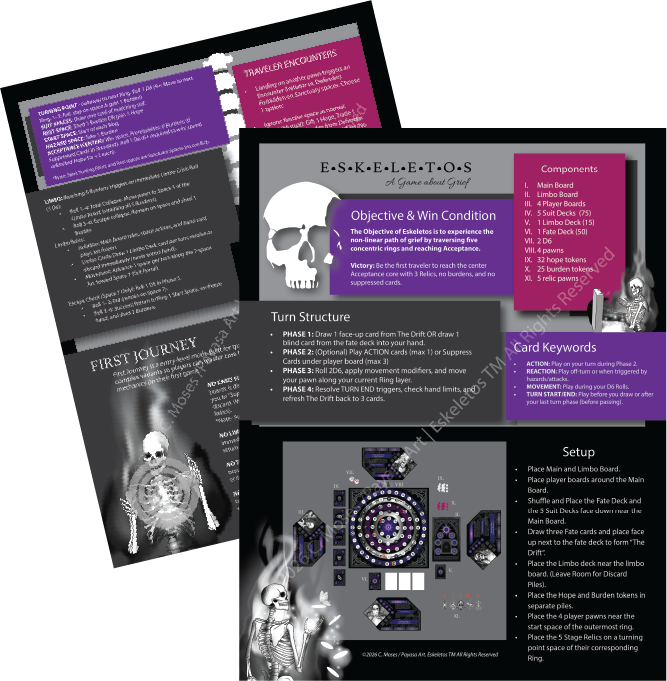
Main Rulebook
TABLE OF CONTENTS
Card Types
Grimoire Edition
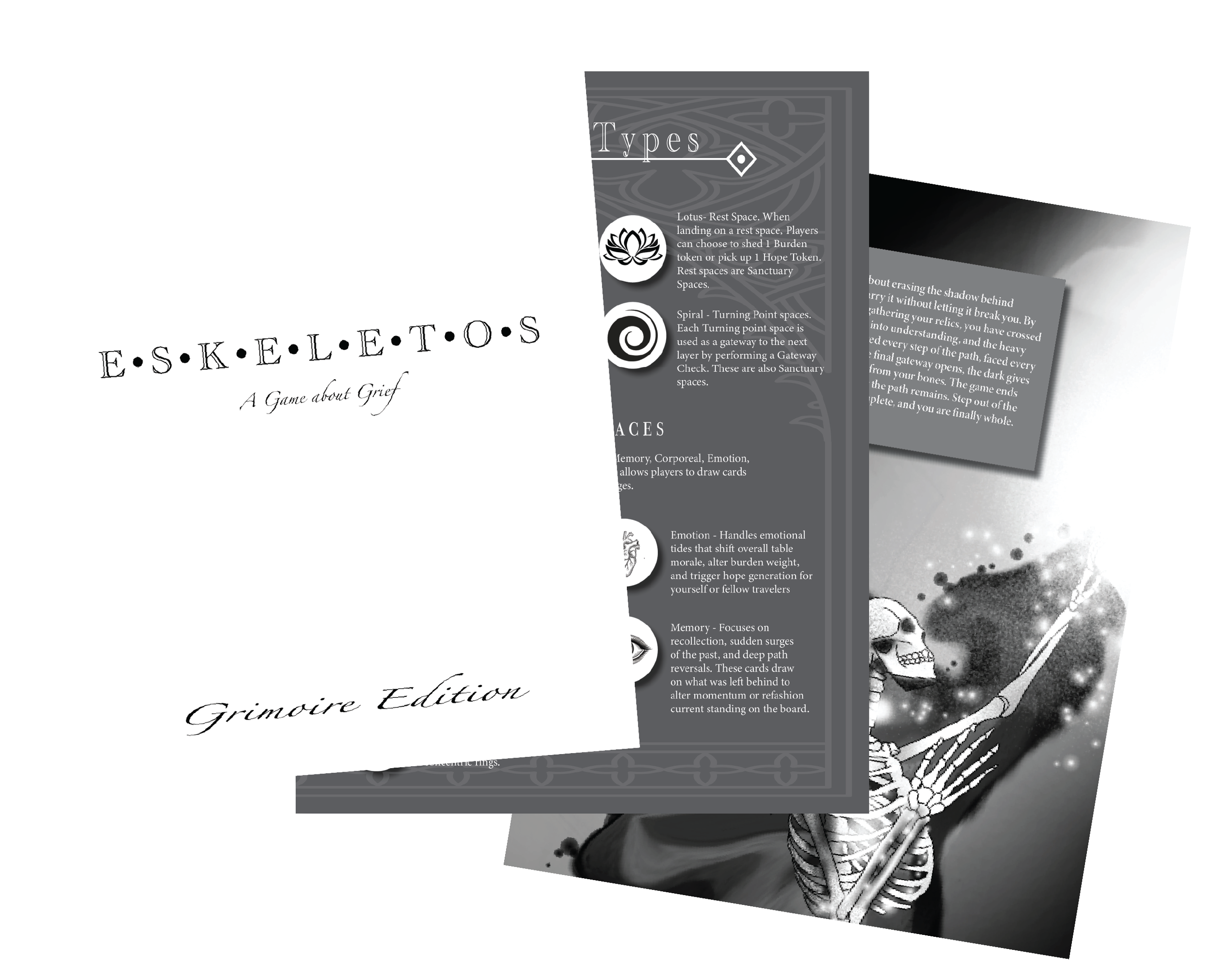
Coming Soon - Join Our Email List for Updates
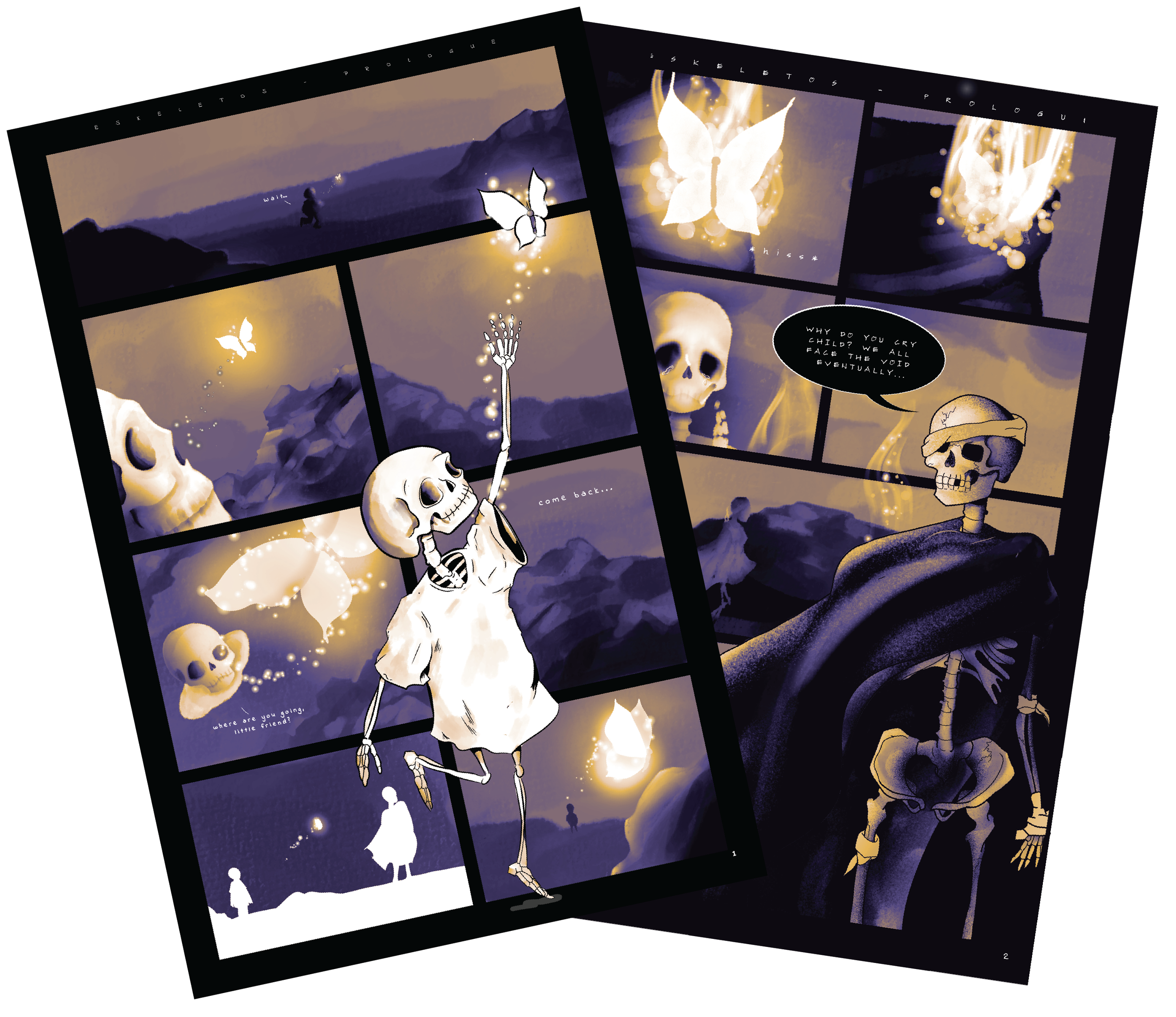
Experience the narrative heart of ESKELETOS. Beyond standard rules and mechanics, the Grimoire Edition transforms the rulebook into an atmospheric artifact—combining core game instructions with an exclusive graphic novel prologue, deep thematic lore, and curated mental health crisis support resources.
Digital Preview Coming Soon!
GAME OVERVIEW
ESKELETOS is a high-stakes thematic tabletop game about emotional processing, personal baggage, and the journey toward acceptance. Each Player controls a Traveler attempting to move inward through five concentric rings representing 5 Stages of Grief in order to reach Acceptance.
The first Traveler to reach the central Acceptance space while satisfying all victory requirements wins the game.
COMPONENTS
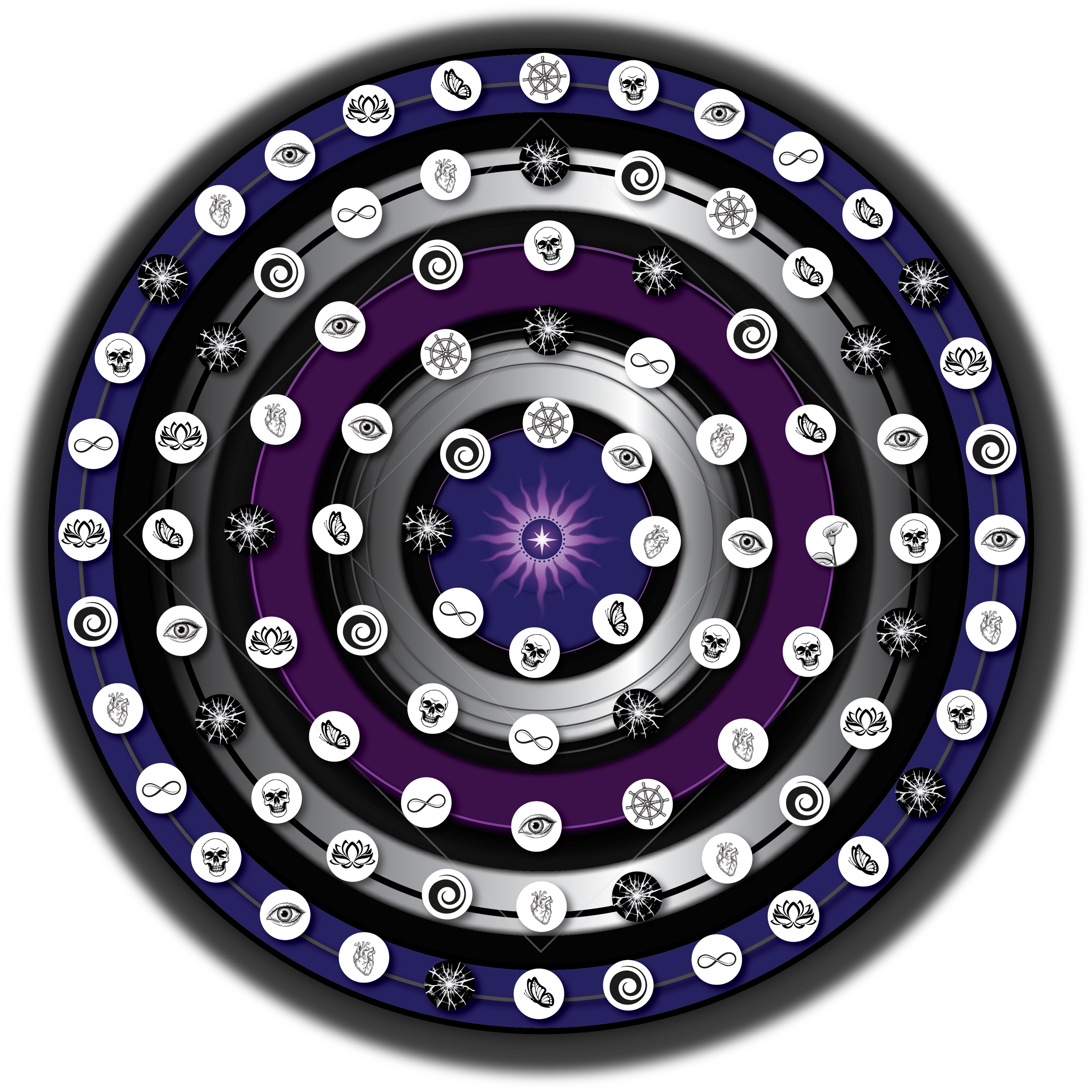
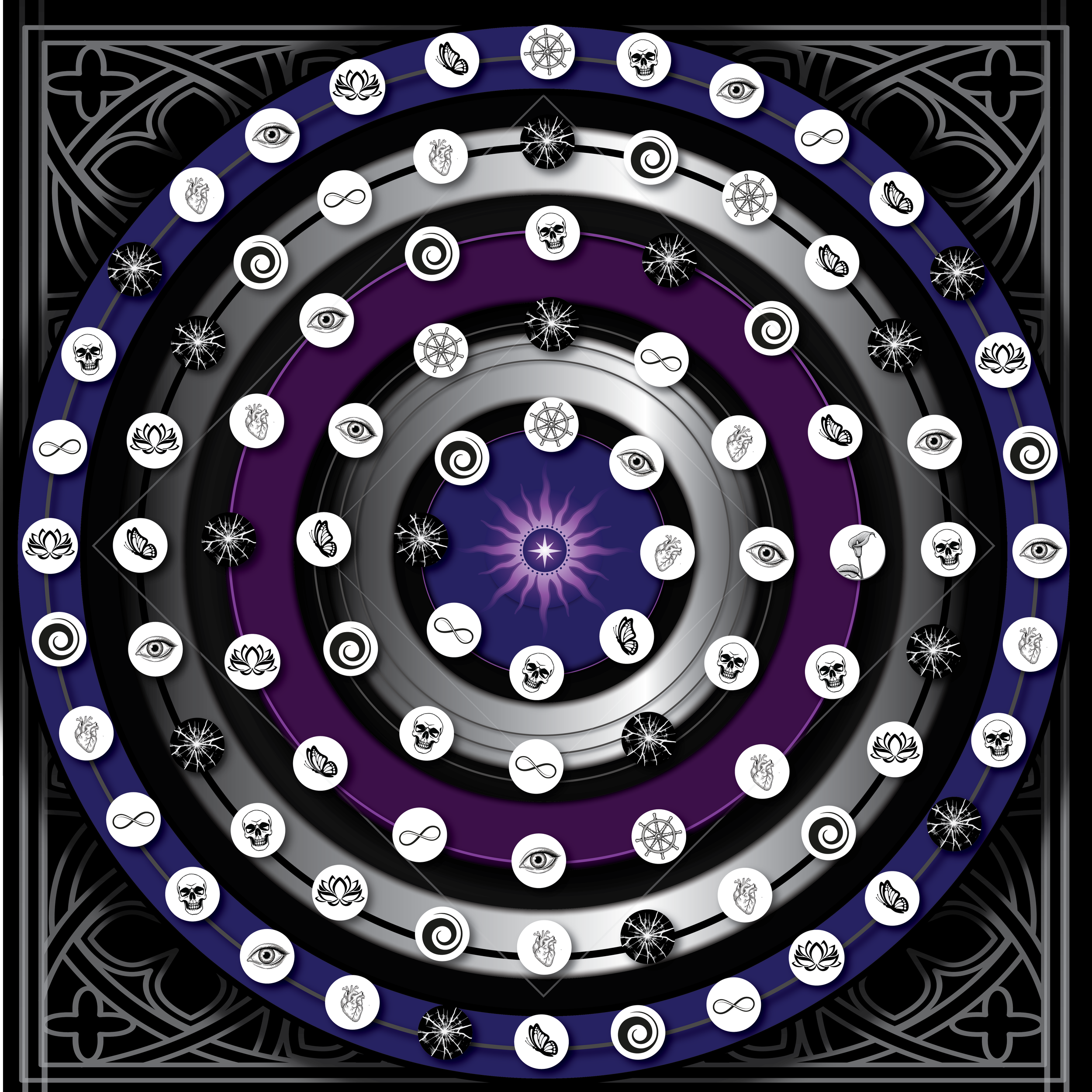
Main Board - A 20 x 20 Quad fold board featuring 5 concentric rings and 92 playable spaces total. The themed rings (In order from the outermost ring: Shock, Anger, Denial, Bargaining, Depression) lead to a central space representing the concept of Acceptance.
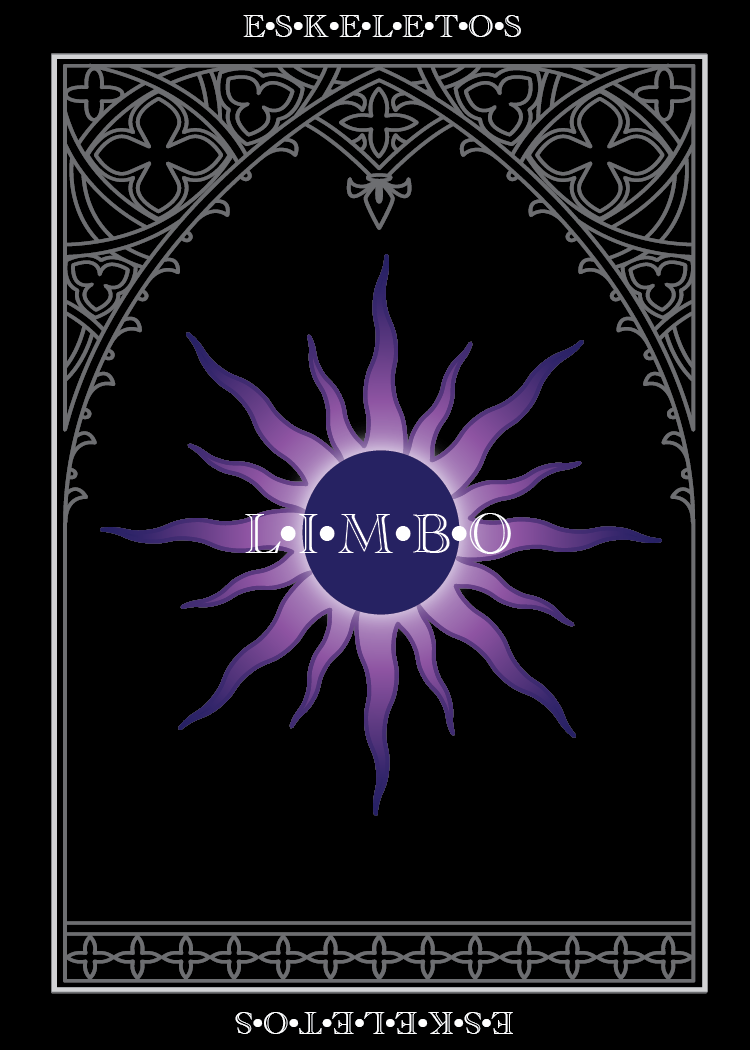
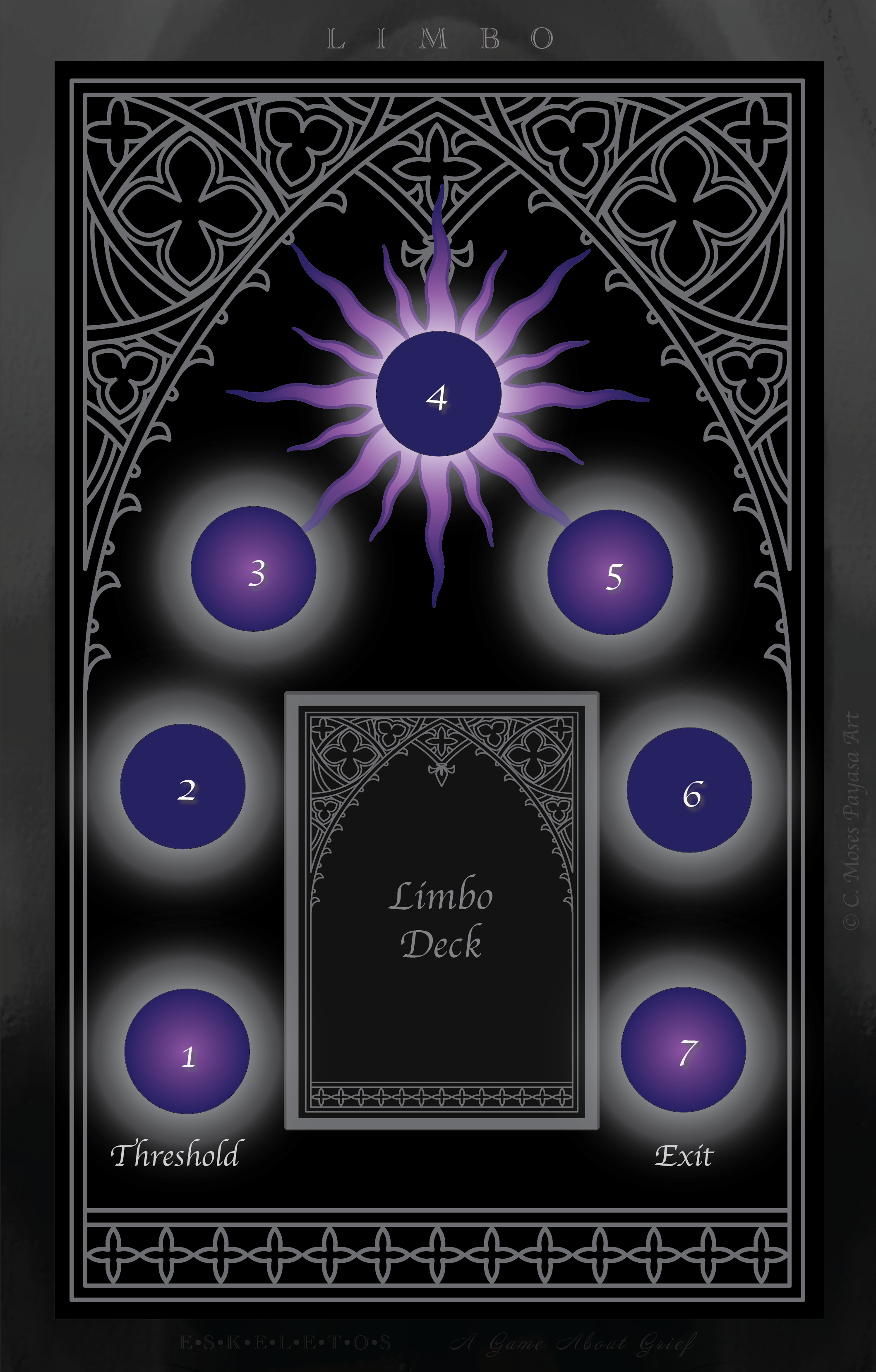
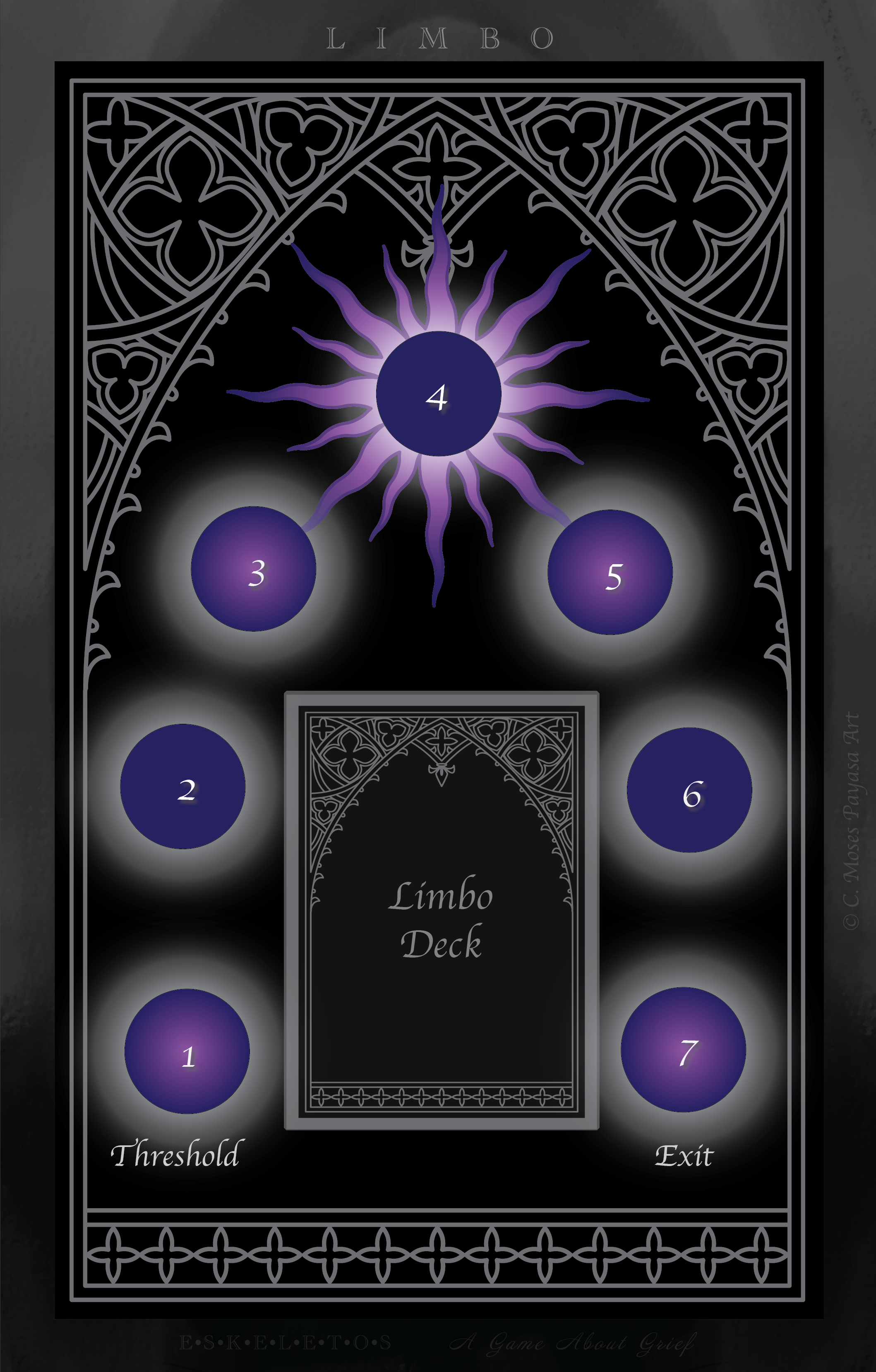
Limbo Board - A 7 x 11 board featuring an archway with 7 spaces representing a recovery track for Travelers (Players) who suffer Total Collapse.
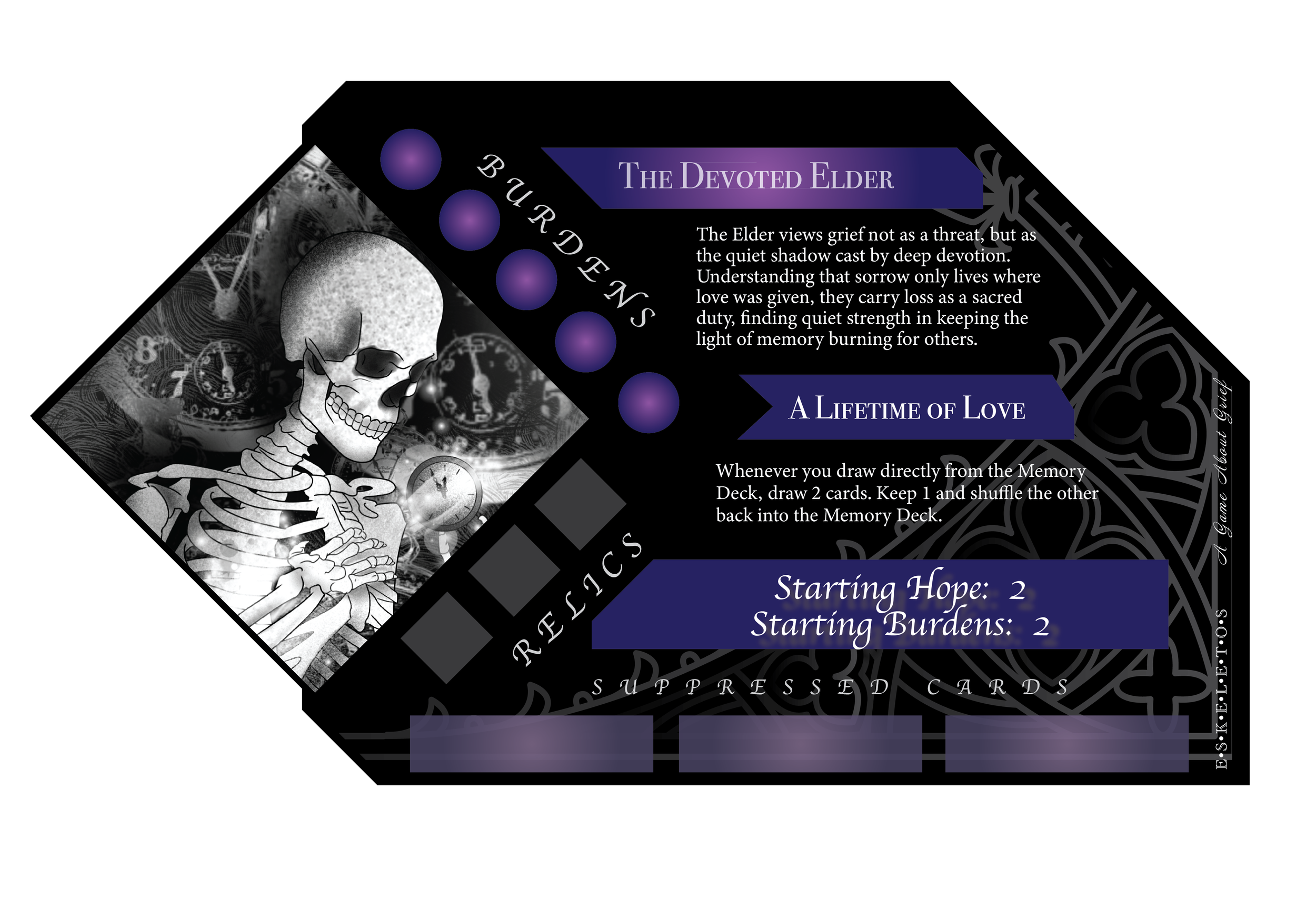
Player Boards - 4 Player boards, each featuring a unique Traveler archetype and corresponding abilities and limitations. Each Player board includes space for 3 Relics, Burden and Hope token spaces, and space for suppressed cards.
Player Pawns - 4 themed pawns
Burden Tokens - 25 Tokens representing burdens acquired throughout the journey. (20 + 5 spare)
Hope Tokens - 32 Tokens representing Hope, which assists Travelers in reaching Acceptance.
Card Decks: 7 card decks including:
5 Suit Decks of 15 cards each representing 5 influences to the Travelers journey - Nature, Corporeal Form, Emotion, Memory, and the Void.
1 Main Fate deck of 50 cards - includes high impact suit events,global fate events, and hazards.
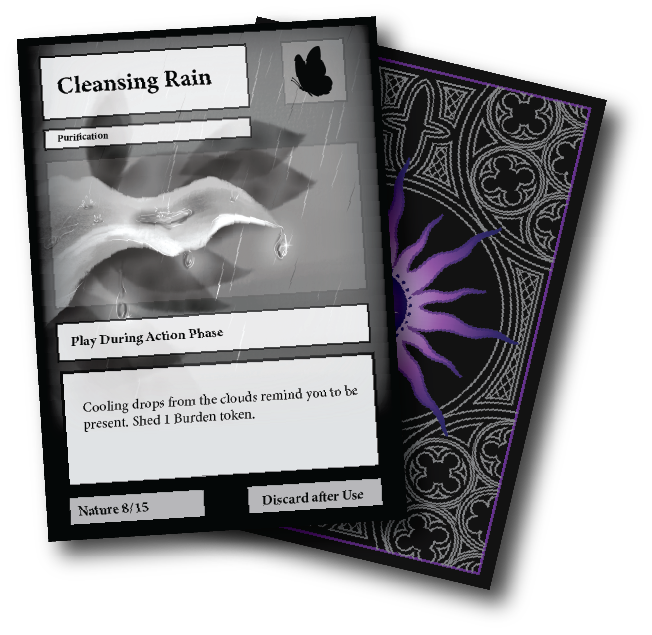
1 Limbo Deck of 15 Cards
SPACE TYPES
The Main Board contains nine space types.
Ship’s Wheel- Start space for each ring layer. Start spaces are considered Sanctuary spaces (no Player conflict on Sanctuary spaces.)
Spiral - Turning Point spaces. Each Turning point space is used as a gateway to the next layer by performing a Gateway Check. These are also Sanctuary spaces.
Shattered Circle - Hazard spaces. When a Traveler lands on a Hazard Space, they gain 1 Burden Token unless protected by an ability or effect.
Lotus- Rest Space. When landing on a rest space, Players can choose to shed 1 Burden token or pick up 1 Hope Token. Rest spaces are Sanctuary Spaces.
Suit Spaces - Correspond to the 5 Suits of the game- Corporeal Form, Nature, Void, Emotion, and Memory. When landing on a Suit space, draw 1 card from the corresponding deck.

Card Type Overview
The Limbo Deck governs the threshold space of the secondary 7-node archway board, acting as the mechanical engine for players who have drifted off the main concentric tracks or become overwhelmed by burdens. Unlike suit cards played from hand or Fate cards that affect the entire board, Limbo cards are drawn and resolved specifically during a Traveler's time within the "In-Between" realm.
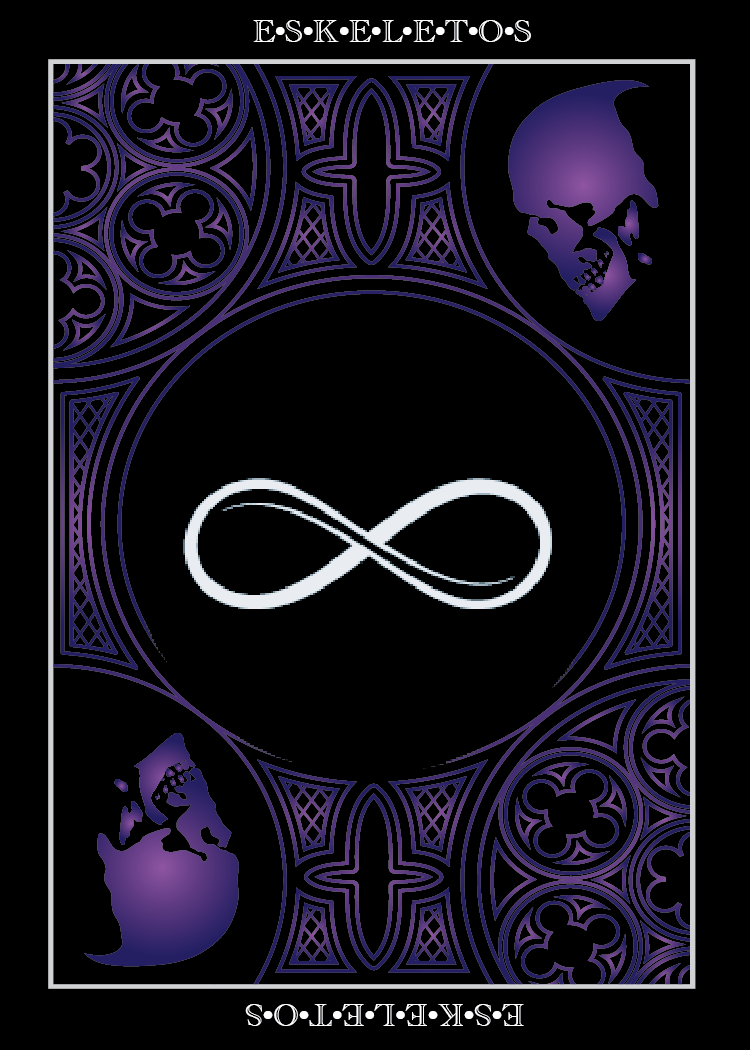
Fate cards represent external circumstances beyond player agency, while the five main suit decks represent internal and physical dimensions of the experience:
Nature Deck: Covers environmental cycles and external natural forces.
Corporeal Form: Handles physical vulnerability and body states.
Emotion Deck: Governs psychological and feeling states.
Memory Deck: Focuses on past attachments and lingering thoughts.
Void Deck: Manages cosmic level, unpredictable events.
STAGE RELICS
Five unique Stage Relics exist in the game. Each Relic corresponds to a ring on the main board and grants a unique ability while holding the Relic.
Each Relic begins on any Turning Point of its corresponding Ring. A Traveler may claim a Relic by landing on its Turning Point while the Relic is present there. Claimed Relics are placed into an open Relic slot on the Traveler's Player Board.
*Note: A Player may not hold more than 3 Relics. If a Player lands on a Turning Point space with a Relic when they are at capacity, they may swap a Relic from their card with the one on the current space.
Relic Displacement
If a Traveler loses a Relic as the result of a Conflict, return that Relic to any Turning Point of its corresponding Ring. (See Traveler Encounters)
A displaced Relic may therefore be reclaimed by any Traveler who subsequently lands on that Turning Point.
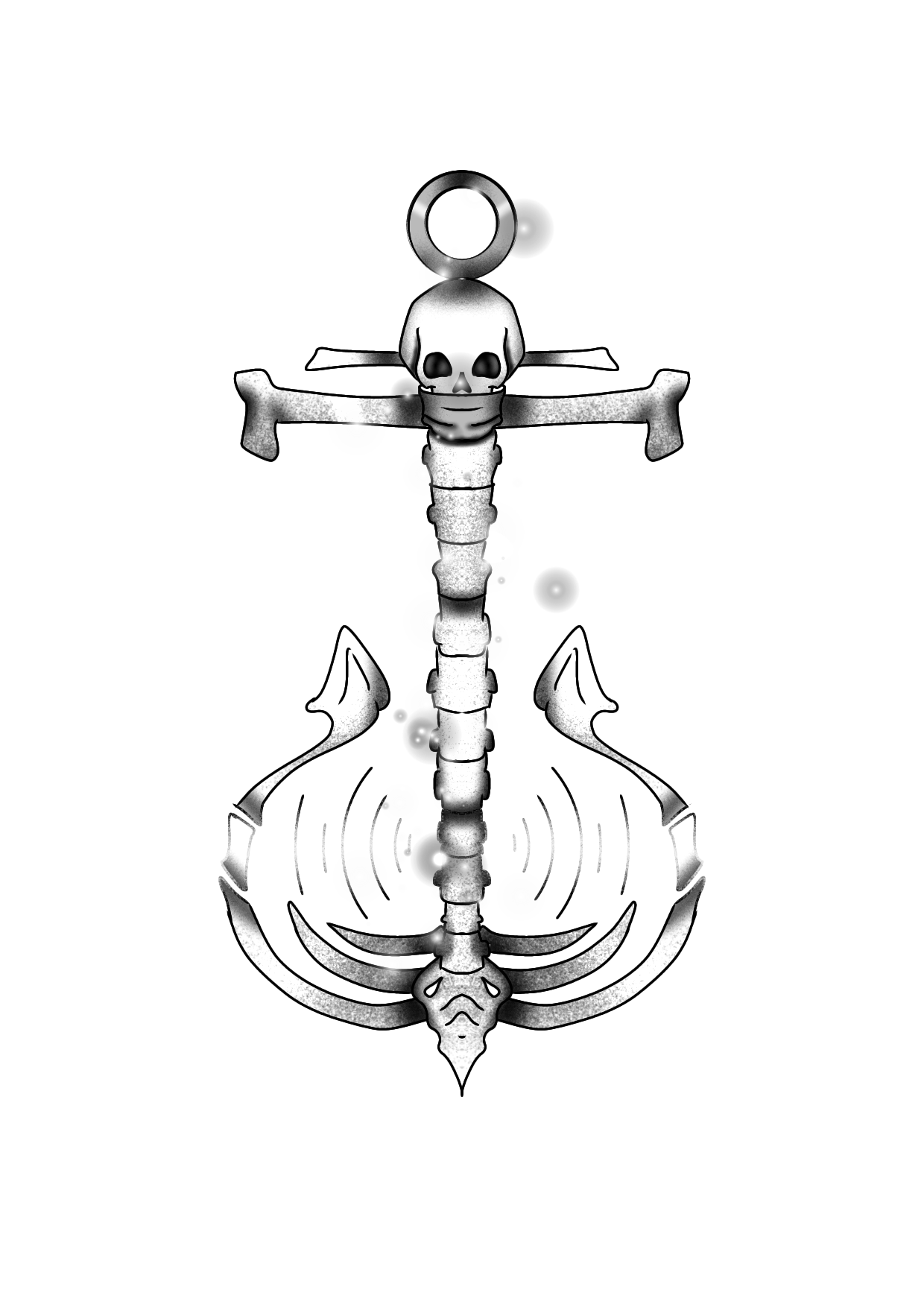
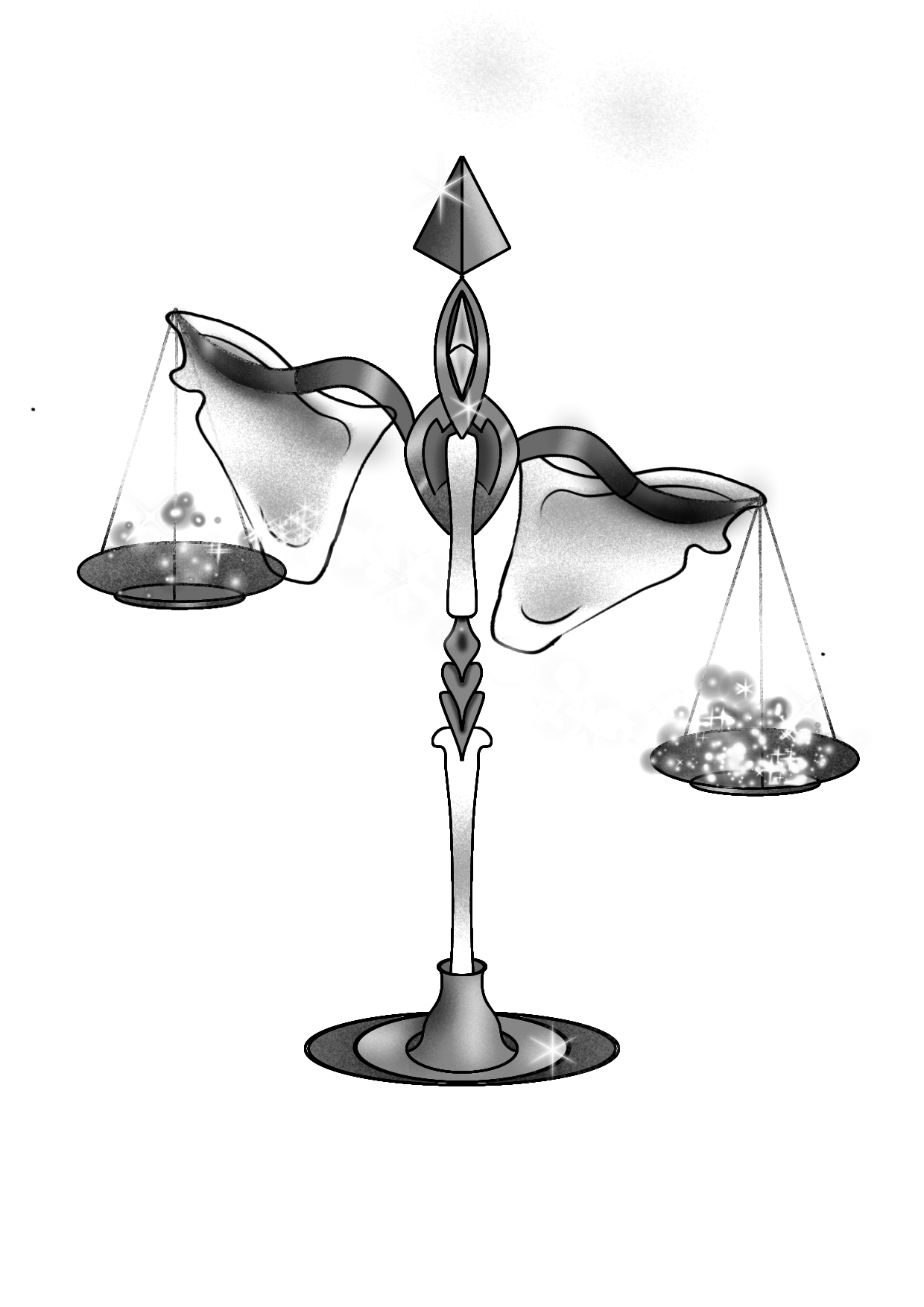
-
PLAY ON TURN START
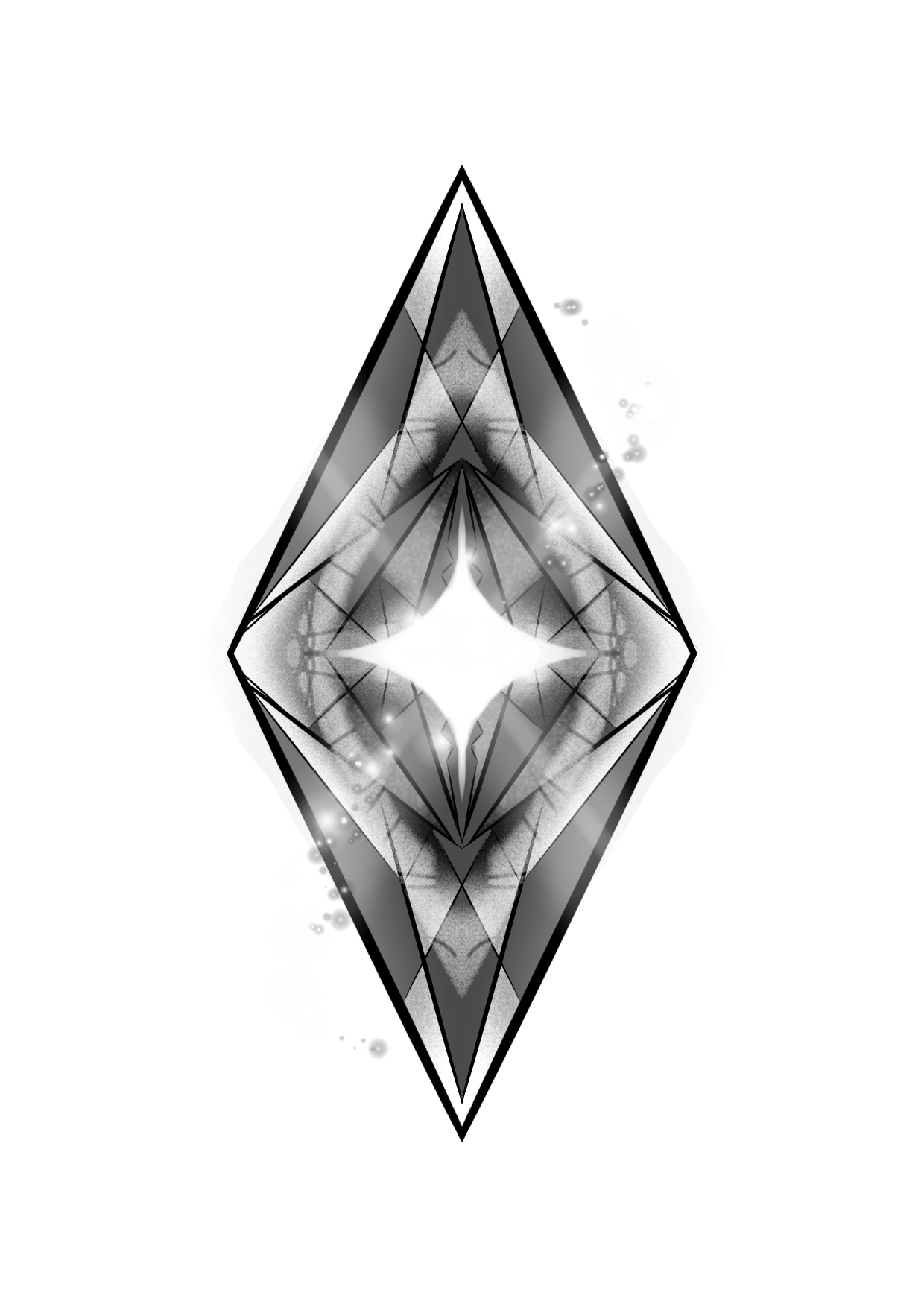
FATE MANIPULATION
Peek at the top 2 cards of the Fate Deck. Place 1 on the bottom of the deck and return one to the top before making your Phase 1 draw action.
-
PLAY ON MOVEMENT OR ACTION PHASE
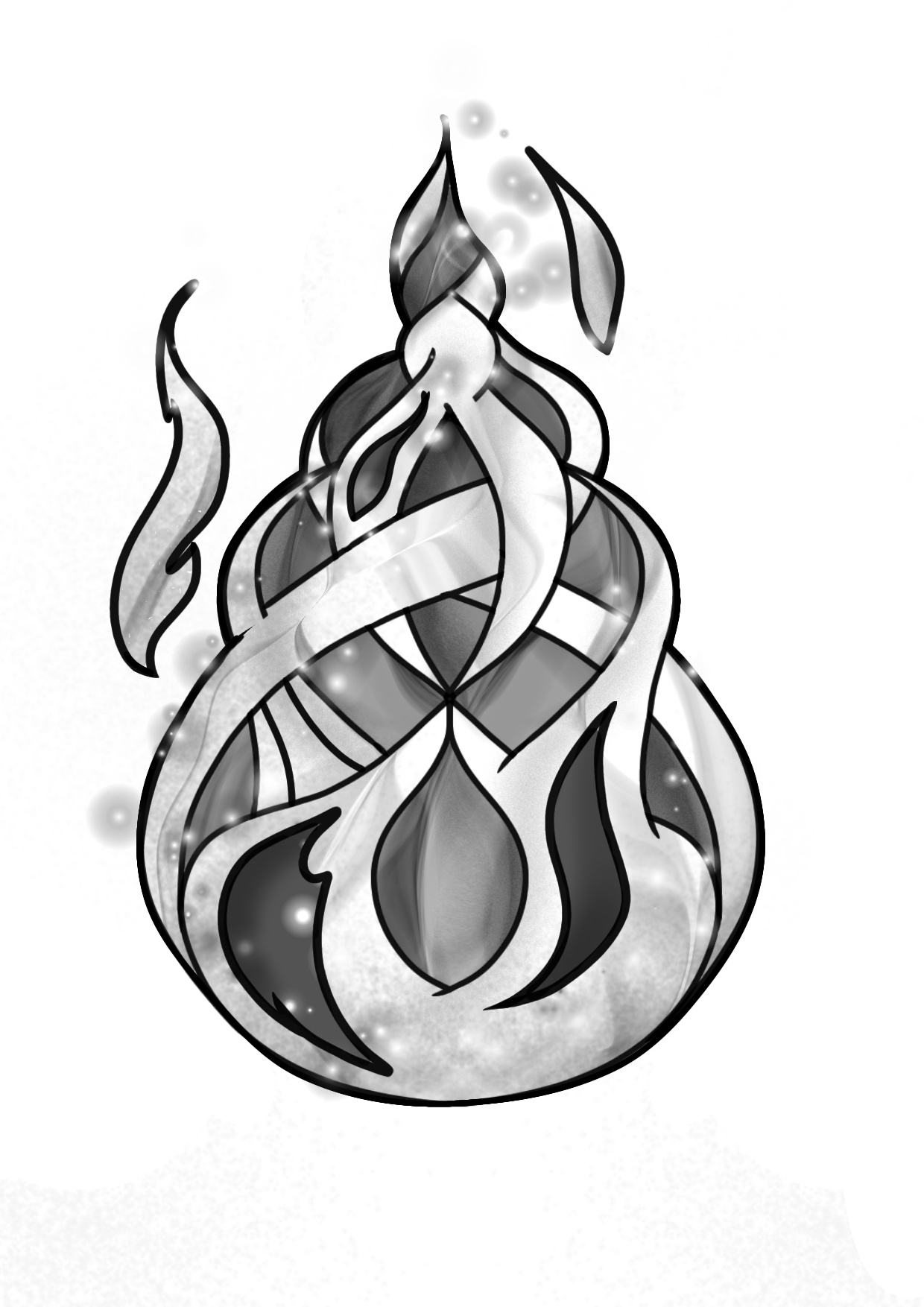
ETHEREAL EMBER-
Add +3 spaces to your Phase 3 movement roll OR spend 1 Hope token to instantly shed two Burdens back to the supply.
-
PLAY DURING ACTION PHASE
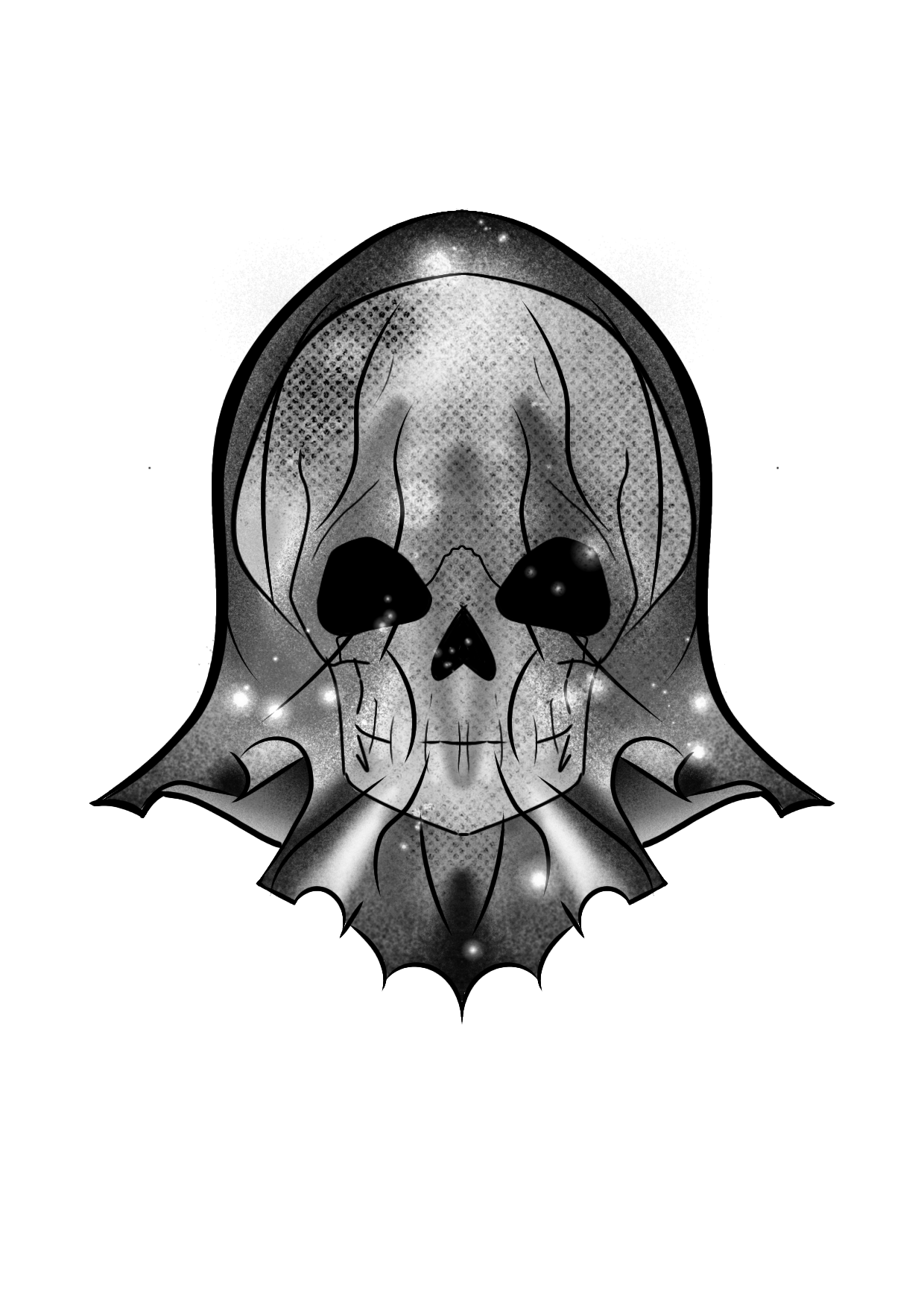
COSMIC CLOAK -
Gain complete immunity to all Ring 4 and 5 Hazard space penalties.
-
PLAY DURING ACTION PHASE
EQUILIBRIUM-
Discard 1 hand card to shed 1 Burden, un-suppress 1 card for free, OR draw 2 Suit cards from any deck.
-
PLAY DURING ACTION PHASE/ AS REACTION
STASIS SHIELD -
Activate when targeted by a card effect, hostile attack, or when landing on a Hazard space: completely negate its effect, forced movement, or Burden gain.
GAME SETUP
Board Layout:
Place the Main Board in the center of the play area and set the Limbo Board beside it.
Place each Stage Relic onto the Turning Point space of its corresponding Ring on the Main Board.
Deck Placement & The Drift:
Deck Placement: Shuffle all 7 decks separately. Place the 5 Suit Decks and the main Fate Deck face-down near the Main Board. Place the Limbo Deck face-down near the Limbo Board, ensuring dedicated space for each deck's discard pile.
Populating The Drift: Deal 3 cards face-up from the Fate Deck adjacent to the Main Board to establish The Drift display.
Capacity Limit: The Drift maintains a baseline of 3 face-up cards at all times (expanded to 4 cards max only when a player uses The Devoted Elder’s character ability).
Setup Hazard Clearance: If a Hazard card is revealed while populating The Drift during setup, discard it harmlessly without triggering its effect and draw a replacement card until 3 standard draftable cards fill the display.
Traveler Selection & Player Board Setup:
Each player selects a Player Board, takes its corresponding pawn, and sets their starting Burden and Hope tokens as indicated.
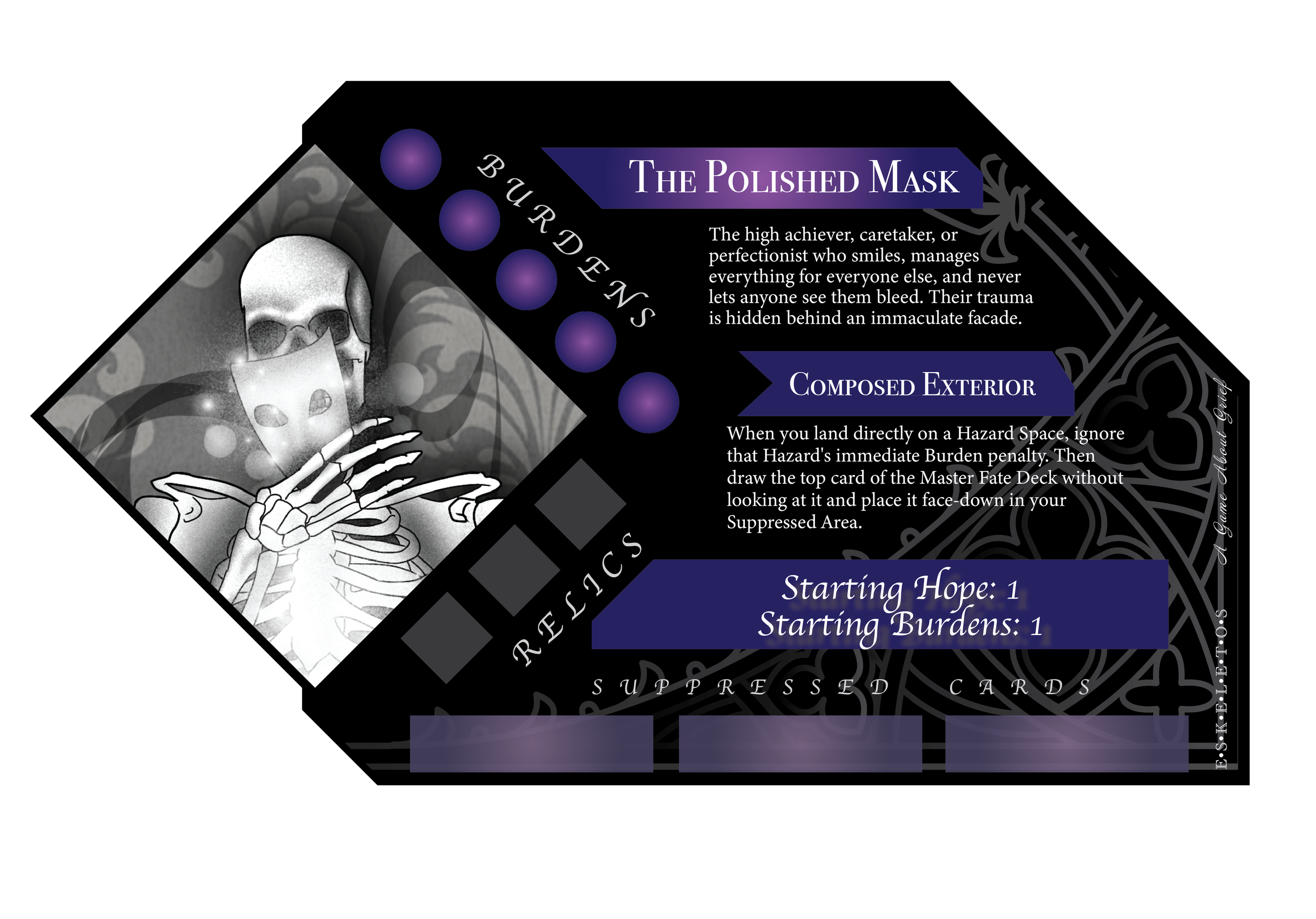
The Polished Mask Setup: If playing The Polished Mask, draw 2 cards face-down from the top of the Fate Deck and place them into your Suppressed Vault. These count toward your normal 5-card Suppression limit and immediately impose standard movement penalties.
Starting Hands & INSTANT Card Handling:
Deal 2 cards face-down from the Fate Deck to each player.
Setup Immunity: If a player draws an INSTANT card during setup, do not resolve its effect. Reveal it, shuffle it back into the Fate Deck, and draw a replacement card.
Starting Requirement: Every Traveler must enter Turn 1 of Round 1 holding exactly 2 playable, non-INSTANT cards.
Pawn Placement & Turn Order:
Place each Traveler pawn on or adjacent to the Start space of Ring 1 (outermost Ring).
Determine starting turn order: Each player rolls 1D6. The highest roll takes the first turn, with turn order proceeding clockwise. (Re-roll ties for highest).
PLAYER ROUND AND TURN STRUCTURE
Each round concludes when each Player has taken their turn. Every turn consists of three mandatory phases: Draw, Movement And Action, and Resolution.
Turn Structure:
Phase 1: Draw
Static Cleanse (Optional): At the very start of your turn, you may spend Hope tokens to perform a Static Cleanse, discarding Suppressed cards or shedding Burdens from your Vault.
Draw Action: Choose one of the following:
Draw 1 card facedown from the top of the main Fate Deck —OR—
Draw 1 card faceup from The Drift display.
Drift Refill & Hazard Trigger: Immediately refill empty Drift slots with the top card of the Fate Deck. If a Hazard card is revealed during a refill, resolve its global event immediately, place it in the discard pile, and draw a replacement card until the Drift slot contains a standard draftable card.
Phase 2: Movement & Actions
Movement (Mandatory):
Roll 2 D6 for board movement.
Apply any modifiers, including character abilities, cards, etc.
Move your Traveler Pawn clockwise along your active Ring equal to the final total.
Space Resolution & Encounters (Immediate):
Space Effects: Resolve the landed space type immediately (Suit Draw, Hazard Burden, Rest, Turning Point).
Traveler Encounters: If landing on a space occupied by another Traveler, initiate a Traveler Encounter immediately(conflict, ignore, or assist/share). (*Note disabled in First Journey mode).
Action Card Play (Optional):
Play an Action Card from your hand, resolving effects immediately and placing it in the matching discard pile.
Phase 3: Resolution & Transition
Hand Limit Check: Verify hand size. If holding more than 5 cards, discard excess cards to their respective suit discard piles.
Pass Turn: Pass turn clockwise to the next Traveler.
First Journey
ESKELETOS: First Journey An introductory setup designed to teach core mechanics and card play by streamlining complex subsystems.
No Card Suppression: Tucking cards under player boards is disabled. Any card effect or penalty instructing you to "Suppress" a card is treated as a standard hand discard.
No Limbo Sideboard: Reaching 5 Burdens causes an immediate emotional reset: shed 2 Burden tokens and return your pawn to the Ring 1 Start Space.
No Traveler Encounters: Multiple pawns may occupy the same space safely without initiating conflict or trading.
No Relics: Relic claiming is disabled.
*Note: First Journey Win condition becomes reaching Acceptance with 0 Burdens + passing the Acceptance Check.
RING TRAVERSAL AND GATEWAY CHECKS
To move from one Ring to the next, a Traveler must land on a Turning Point space. Turning Point spaces are Sanctuary spaces where no conflict may occur.
When landing on a Turning Point space, the Traveler may choose whether to attempt a Gateway Check:
Opting Out: The Traveler may choose not to roll.
Attempting the Check: The Traveler rolls 1 D6.
Standard Requirement: A net result of 4+ (rolls of 4, 5, or 6) is required to pass across all ring layers.
Spending Hope: Before determining the final result, the Traveler may spend 1 Hope token to add +1 to the Gateway Check roll result. Only 1 Hope token may be spent per Gateway Check.
If the Roll is a Success: Move the Traveler to the Start space (Ship's Wheel) of the next ring layer.
If the Roll Fails (1–3): Gain 1 Burden token and remain on the Turning Point space. (If the Burden gained is the active player’s 5th, resolve a Limbo Crisis Roll immediately.)
TRAVELER ENCOUNTERS
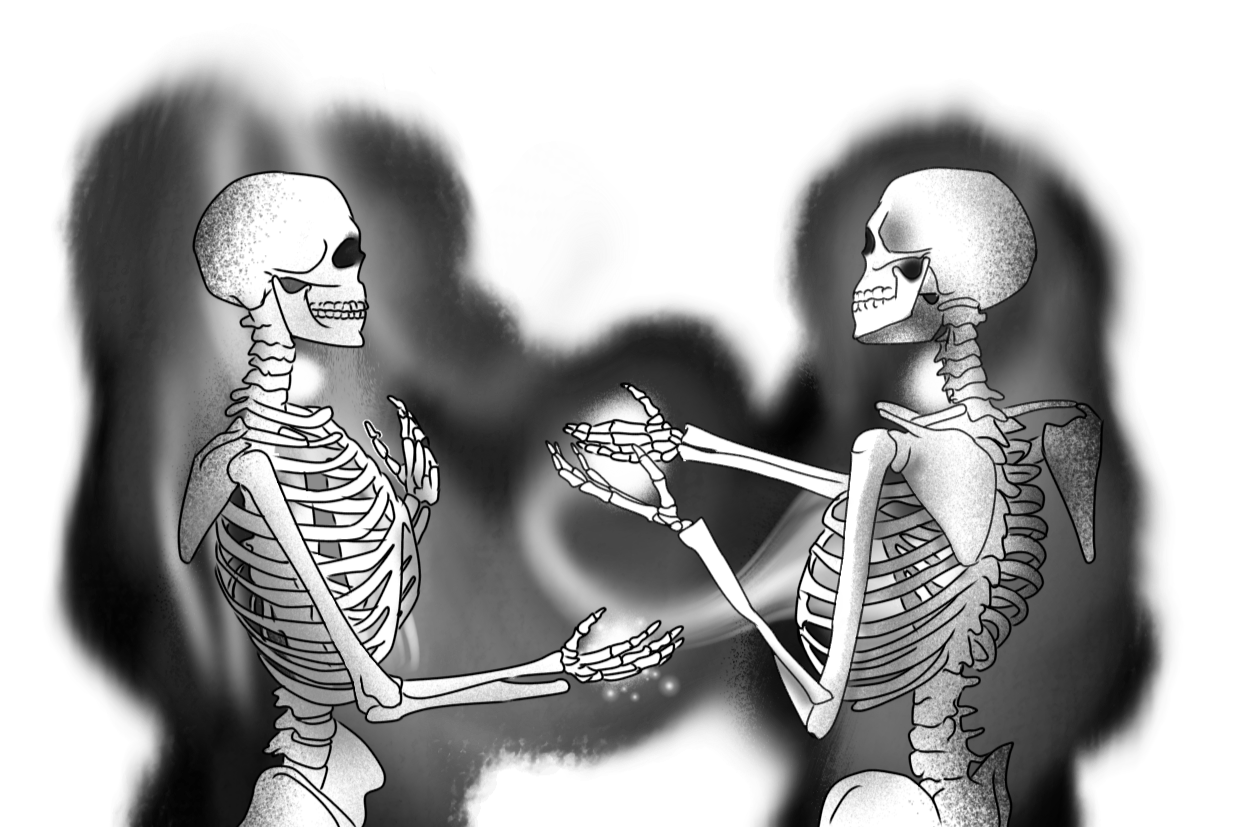
When a Traveler lands on a space occupied by another Traveler, initiate an Encounter. The active Traveler is the Initiator, and a Traveler already occupying the space is the Defender.
If multiple Travelers occupy the space, the Initiator chooses which one will be the defender. The Initiator chooses one of three options: Assist/Share, Ignore, or Conflict.
Assist/Share - Assist is cooperative and occurs by mutual agreement. The Initiator may choose one of the following actions (only one per encounter):
Gift 1 Hope to the Defender
Trade 1 Card with the Defender
Take a Burden from the Defender
Ignore - The Initiator may choose not to act. The space is resolved normally.
Conflict - The Initiator challenges the defender to a fate contest. Both Players roll 1 D6 and apply all applicable modifiers. Note: Hope may not be spent on a fate contest unless a card specifically permits it. After a conflict resolves, the Initiator resolves the underlying space normally unless the conflict effect specifically changes the Traveler’s position or states otherwise.
Conflict Results
Defender Wins or Ties: Nothing happens.
Initiator wins by 1- 2: The Defender gains 1 Burden.
Initiator wins by 3+: The defender gains no additional burdens but must surrender one stage relic back to a turning point on its corresponding ring. (See Relics)
Conflict Restrictions
Conflict cannot be initiated in Sanctuary spaces, however, the Initiator may still choose to assist or ignore the Defender.
BURDEN
Burdens represent accumulated emotional weight. Burdens are tracked with physical Burden tokens on the Player board. Whenever an effect instructs a Traveler to gain Burdens, place the specified number of Burden Tokens on their board. If the Traveler reaches 5 Burdens, immediately stop resolving the current sequence and perform a Limbo Crisis roll.
LIMBO & RECOVERY
Limbo represents a state of being completely lost—a temporary isolation and processing zone located off the Main Board. While trapped in Limbo, a Traveler is disconnected from the main Ring progression, focusing entirely on surviving the internal shadow and navigating toward an Exit Portal.
Limbo Crisis Roll
When a Traveler reaches their 5th Burden Token, they immediately roll 1 D6.
If the Traveler rolls a 5 or 6: The Player narrowly escapes and resists Total Collapse. They then remain on the current space and shed one burden at the end of the turn (returning to 4 burdens).
If the Traveler rolls a 1-4: The Player suffers a Total Collapse due to emotional strain. They stop their current turn sequence, retain all 5 burdens and immediately move their pawn to the start space on the Limbo Board.
CONDITIONS OF LIMBO
Main Board Immunity & Isolation: The Traveler does not participate in normal Main Board movement. Main Board rules, space actions, and standard hand card plays do not apply while in Limbo unless a specific Limbo card explicitly instructs otherwise.
Hand Freeze: Cards currently in your active hand remain frozen in place under your board. You do not draw new cards into your active hand during Phase 1 while in Limbo, nor may you play standard hand cards.
Play-or-Discard Deck: Limbo Deck cards drawn during Phase 1 are resolved immediately, played during Phase 2 or 3 of that same turn, or discarded to the Limbo discard pile. Limbo cards never enter a Player's hand.
THE 7-SPACE LIMBO ARC
The Limbo Sideboard features a 7-spacetrack framed within an archway border. Travelers enter at the base and advance toward the escape point at the far end:
Space 1 (Entrance): The landing space when entering Limbo.
Spaces 2–6 (The Arc): Intermediate spaces traversed along the archway track.
Space 7 (The Exit Portal): The final space on the track designated for escape attempts.
LIMBO TURN STRUCTURE
Your turn follows the standard 3-phase rhythm, adapted specifically for the Limbo Sideboard:
PHASE 1: LIMBO DRAW
Draw 1 card from the Limbo Deck.
If the card timing reads "On Draw" or "Start of Turn" (e.g., Whispers in the Dark, Heavy Chains, Deep Cold), resolve its text immediately.
If the card timing reads "Movement Phase," "Action Phase," or "Reaction," set it face-up in front of you to resolve during Phase 2 or Phase 3 of this turn.
PHASE 2: MOVEMENT PHASE
Movement in Limbo is card-driven and sequential; the D6 is not rolled for standard movement distance.
Apply Card Modifiers: Resolve any movement card effects played or drawn (e.g., Spectral Drift advances your pawn +2 spaces; Void Passage moves you directly to Space 7).
Take Natural Step: If your pawn’s movement is not frozen by a card effect (e.g., Static Void, Deep Cold), advance your pawn 1 space forward along the track toward Space 7.
PHASE 3: ACTION & EXIT PHASE
Play Action Cards: Resolve any "Action Phase" cards held in front of you (e.g., Soul Echo, Anchored Soul, Portal Surge, Guiding Thread).
Attempt Escape Check (Space 7 Only): If your pawn is currently sitting on Space 7 (The Exit Portal), perform an Escape Check during Phase 3 by rolling a D6:
Roll 1–2 (Failure): Your pawn remains on Space 7 and your turn ends. You may attempt the roll again on your next turn (or play a card to modify the outcome).
Roll 3–6 (Success): You break free! Immediately return your pawn to the Start Space of Ring 1 (Shock) on the Main Board and shed 2 Burden Tokens back to the supply.
Clean-Up: Discard your resolved Limbo card to the Limbo discard pile. Your turn ends.
RETURNING TO THE MAIN BOARD
Upon successfully escaping Limbo (via a successful Exit Check roll on Space 7 or a card effect such as Portal Surge or Pure Transcendence):
Your active hand un-freezes and standard hand management resumes.
Your pawn is placed on the appropriate Main Board re-entry space as designated by the escape method. (The starting space of Ring 1, unless a card instructs otherwise.
Main Board movement and card play resume as normal starting on your next turn
CARD MOVEMENT, SUPPRESSION AND ATTACHMENTS
Card Exhaustion - All Decks
When cards are exhausted in any pile, reshuffle the discard pile and replace the main pile.
Keep In Play
Some cards are labeled Keep in Play. These cards are placed in the active play area rather than being discarded after resolution. They provide ongoing effects (Ex: Companion Animal, Genetic Strength, Keepsake.) Unless a card says otherwise, an Attachment remains active until removed.
Attachment Removal & Discard
An active attachment (Keep in Play card) leaves a Traveler's board and enters the appropriate Discard Pile under three conditions:
Forced Removal (Destruction): Card effects, hazards, or catastrophic events instruct a player to target and discard an attachment.
Voluntary Discard (Recovery): Specific card instructions or abilities allow a player to voluntarily discard an attachment to pay a cost or trigger an effect.
Limbo Strip (Total Collapse): When a Traveler suffers Total Collapse and enters Limbo, all active attachments on their board are immediately stripped and discarded.
Note: Unless explicitly stated otherwise, always send removed attachments directly to their corresponding deck's Discard Pile.
Note: Suppressed cards are not counted as attachments.
THE CARD SUPPRESSION & HAZARD SYSTEM
Suppressing a card represents bottling up, hiding, or burying heavy trauma rather than processing it.. Suppressed cards are placed face-down in the designated Suppressed card area beneath your Player Board.
1. Movement Penalties & Capacity
Movement Reduction: For every card currently held face-down in your Suppressed Area, subtract 1 from your Phase 2 Movement Roll. This penalty applies after rolling the die.
Minimum Movement Floor: Your net movement roll cannot be reduced below 1 space. (Example: A natural roll of 2 with 3 Suppressed Cards equals a net movement of 1 space).
Suppression Capacity: A Traveler may hold a maximum of 3 Suppressed Cards beneath their board at any time.
2. Forced Suppression at Capacity
If an effect forces a Traveler to suppress a card while their Suppressed Area is already full (3 cards), execute the following steps in order:
Gain 1 Burden Token due to emotional overload. (If this increases your tracker to 5 Burdens, immediately resolve a Limbo Crisis Roll).
Select 1 existing Suppressed Card from under your board and place it directly into the discard pile without resolving its effects.
Place the newly forced card face-down into the freed Suppressed Area slot.
3. Un-Suppressing & Purging Cards
Un-Suppressing to Hand: Certain cards or abilities allow a Traveler to un-suppress a card and return it to their active hand. Once returned, the card is revealed face-up and counts toward your standard hand limit.
Purging at Gateways: Whenever a Traveler successfully crosses a Gateway into a new ring layer, they may immediately purge 1 Suppressed Card, discarding it directly into its corresponding discard pile.
4. Master Fate Deck: Suppressed Hazards
Suppressed Hazards (10 cards in the master Fate deck) represent latent, volatile trauma. Unlike standard Suit cards, they bypass your hand upon being drawn and go straight face-down into your Suppressed Area.
The Detonation Trap: Standard Suppressed Cards (cards that you choose to suppress) are discarded harmlessly when un-suppressed or purged. A Suppressed Hazard triggers its negative hazard penalty immediately whenever it is revealed face-up, returned to a hand, un-suppressed, or purged to a discard pile.
FATE CARDS
Fate cards are cards from the master Fate deck. When drawing a card during the initial turn sequence, draw from the Fate deck.
When a Fate card instructs a Player to resolve it immediately (Play Immediately) resolve the card then place it into the discard pile unless the card suggests another location.
The Fate deck consists of the following types of cards:
High-Impact Suit Events
These cards produce major effects associated with one or more Suit themes.
Global Fate Events
These cards affect multiple Players or the overall game state. Resolve exactly as instructed on the card.
Suppressed Hazards
Unless an individual card states otherwise, a Suppressed Hazard follows the normal rules for Suppressed cards when placed in the Suppression area of the Player board.
Card and Effect Timing
When multiple effects occur at the same time, resolve them in the following order.
Mandatory Immediate Effects
Active Travelers Character Abilities
Optional Effects (Any instructions that include “a player may…”)
Space Resolution and Cleanup/Turn End
When a rule says “immediately” resolve that effect before continuing with the action currently being performed.
Example: If a Traveler gains their 5th burden while resolving an encounter, the Limbo Crisis Roll must be resolved before the Encounter continues.
Note: If a card explicitly gives a timing instruction, that instruction overrides the general timing order.
Reaching Acceptance and Winning the Game
The Acceptance (center) space is the game’s winning space. A Traveler may attempt to reach Acceptance only after landing on a Turning Point space in Ring 5 (Depression) and satisfying the following prerequisites:
Zero Baggage:
A Traveler must have 0 Burden Tokens
A Traveler must have 0 Suppressed Cards.
A Traveler must possess 3 Stage Relics on their Player board.
A Traveler must pass the Acceptance Check:
Roll 1 D6 - The base requirement for the winning roll is a net of 6. Hope may be spent to improve the Acceptance check. Each Hope token adds +1 to the roll. Hope must be spent before the result is finalized.
Note: Unlike Gateway checks, there is no limit on the number of Hope tokens that may be spent on a core check.
Successful Acceptance Check:
If the roll result (plus modifiers) meets or exceeds the required number:
Move the Traveler onto the Acceptance space. The first Traveler to reach Acceptance wins the game, and gameplay concludes.
Failed Acceptance Core Check:
The Traveler remains on the Ring 5 Turning Point. No Burden is automatically gained, and the turn ends. The Traveler may attempt the Acceptance check again on a future turn as long as they satisfy all prerequisites.
Note: Player must still perform all turn steps as usual on their next turn and cannot immediately attempt the Acceptance check unless landing on the Turning Point space again.
Traveler Archetypes
Grief does not care about age, status, or preparation. The travelers in ESKELETOS represent the broad spectrum of human experience—each entering the descent with asymmetric starting weight, unique emotional mechanisms, and personal motivations.
-
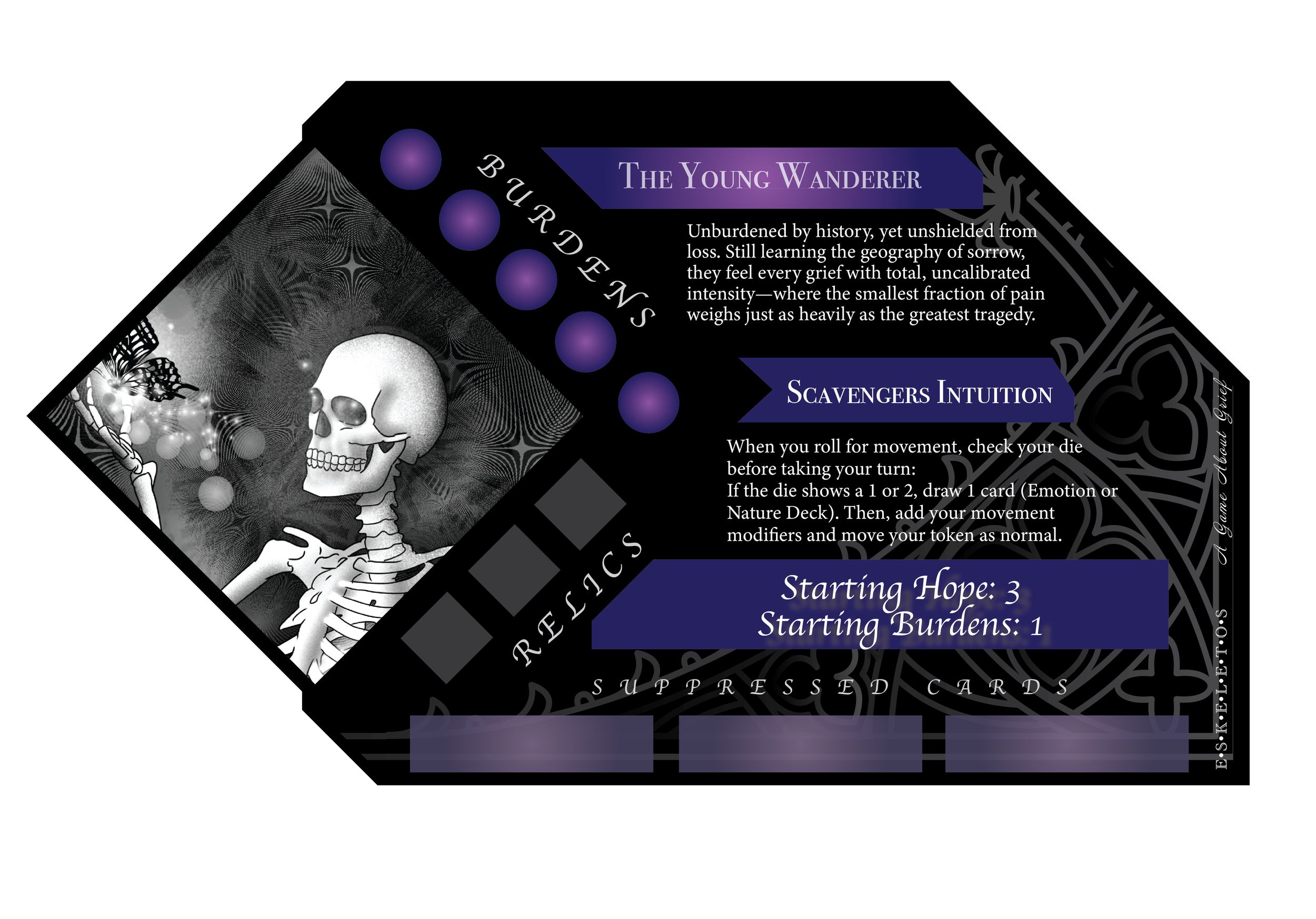
Play Style: High Momentum / Resource Engine
Starting Burdens: 1
Starting Hope: 3
Ability Name: Scavenger's Intuition
Timing: TRAVERSAL
Description: When rolling your 2D6 movement dice during Phase 2, check the individual dice before moving: if either die shows a 1 or 2, draw 1 card from the Emotion or Nature Deck. Then resolve movement as normal.
-
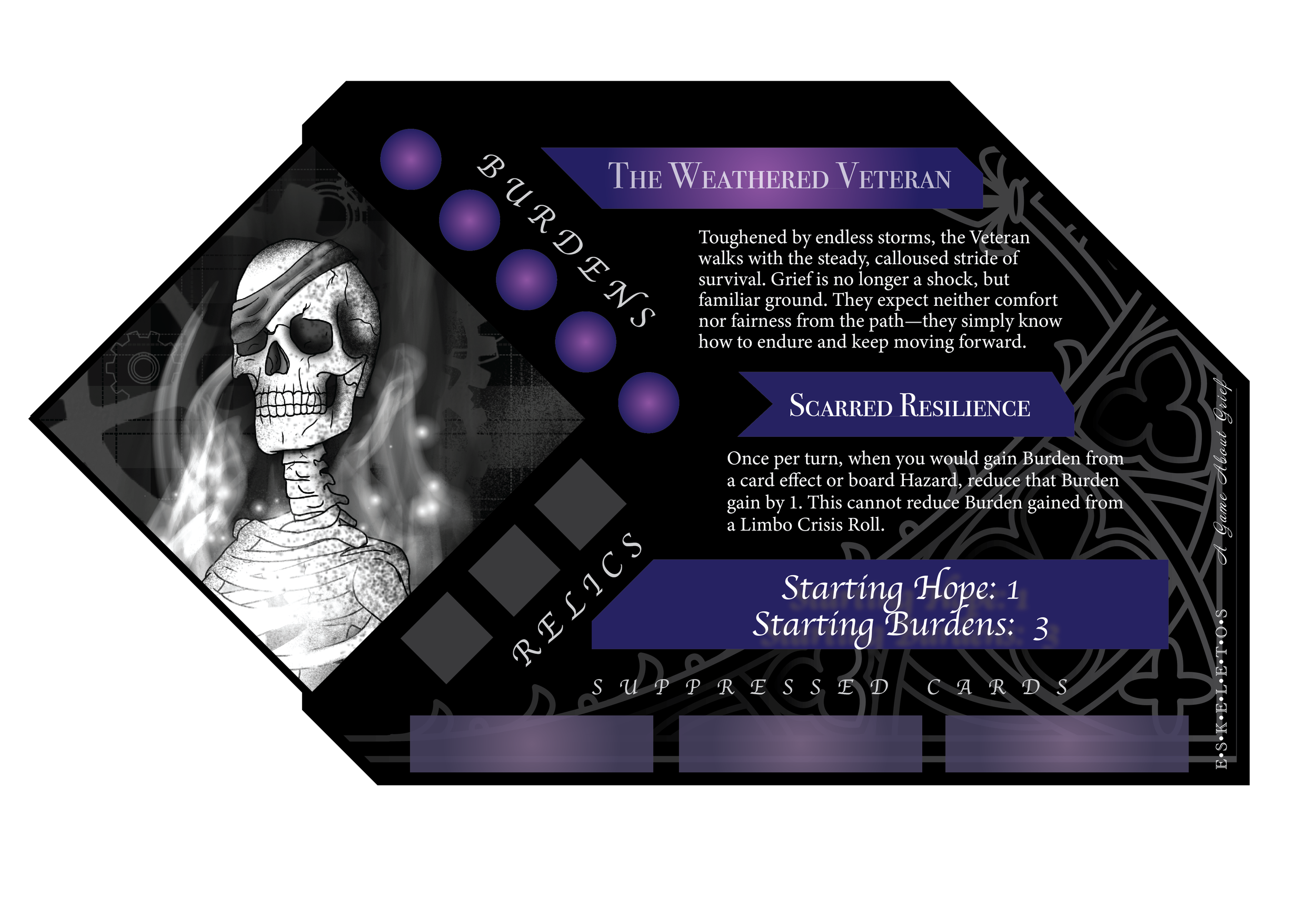
Play Style: Tank / High Burden Endurance
Starting Burdens: 3
Starting Hope: 1
Ability Name: Scarred Resilience
Timing: REACTION
Description: Once per turn, when you would gain 1 or more Burden tokens from a card effect or board Hazard space, reduce that Burden gain by 1. (Cannot reduce Burden gained from a Limbo Crisis Roll).
-
Play Style: Balanced / Card Quality Focus
Starting Burdens: 2
Starting Hope: 2
Ability Name: A Lifetime of Wisdom
Timing: ACTION / TURN END
Description: Whenever you play or discard an ACTION card, you may place it face-up into The Drift as a 4th bonus slot instead of sending it to the discard pile. When another traveler drafts your card from The Drift during Phase 1, gain +1 Hope token. (The Drift then returns to its standard 3-card limit).
-
Play Style: Hidden Risk / Deferred Damage
Starting Burdens: 1
Starting Hope: 1
Ability Name: Facade Purge
Timing: ACTION
Description: Spend 3 Hope tokens and discard 1 active card from your Suppressed Vault to immediately advance your pawn 1 space forward along your current Ring track.
**The Polished mask begins with 2 cards suppressed underneath their player boared. See Game Setup.
GENERAL RULE PRINCIPLES
Specific Rules Override General Rules
If a card or character. ability directly contradicts a general rule, the card or ability takes precedence
Impossible Effects
If an effect requires a Player to perform an action that is impossible, resolve as much of the effect as possible and ignore the impossible portion.
Optional Effects
Effects using “may” are optional.
Effects using “must” or “immediately” are mandatory unless another effect prevents them.
Hidden Information
Cards in a Player's hand are private information. Suppressed Cards are face-down and hidden unless a rule specifically permits the Player to inspect them.